

What is Debt Validation?
Debt Validation: What It Is, How It Works, and How It Can Help Remove Collection Accounts
Quick Answer
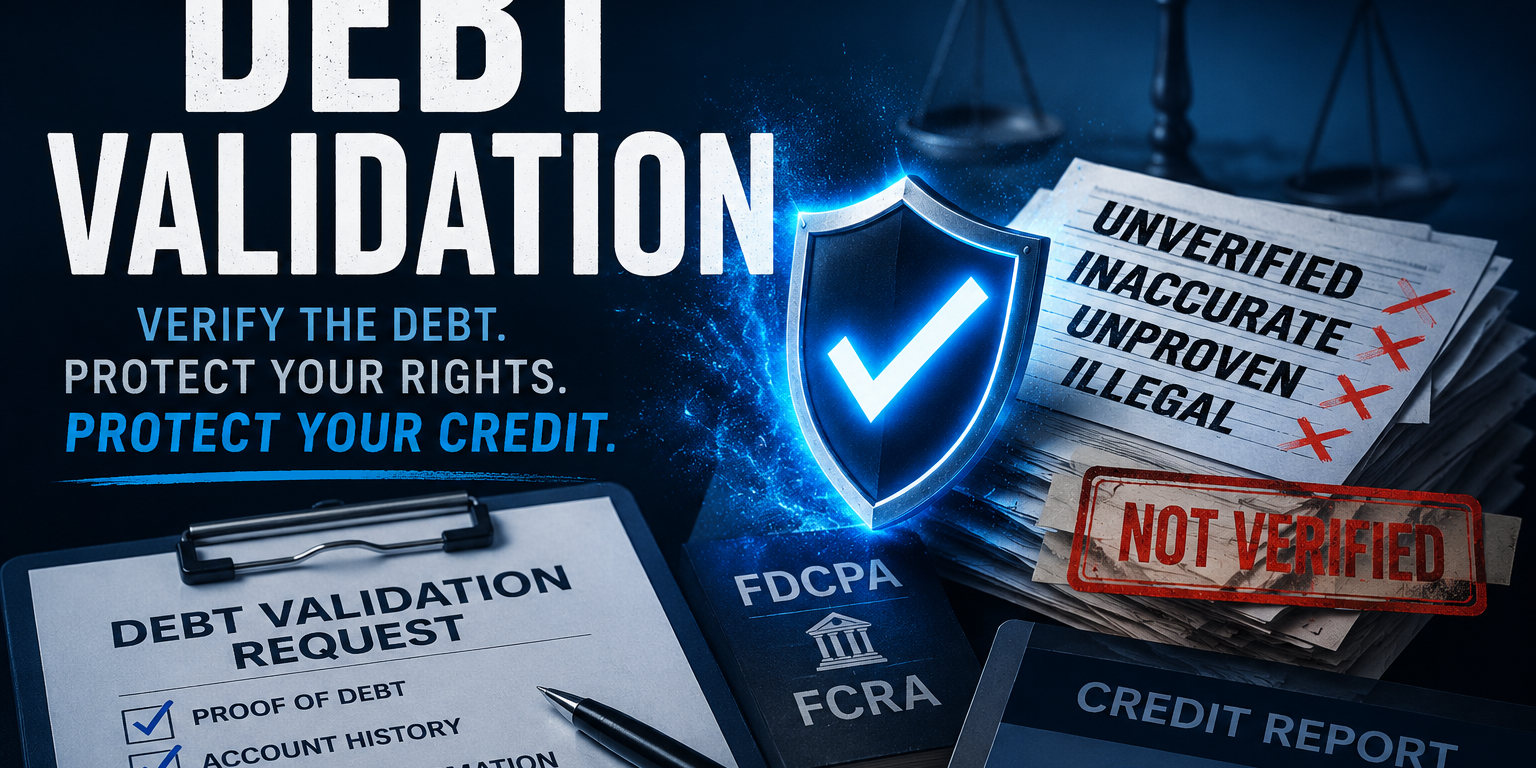
Debt validation is a consumer protection process under the Fair Debt Collection Practices Act (FDCPA) that allows you to request proof that a collection agency has the legal right to collect a debt and that the information being reported is accurate. If the collector cannot adequately verify the debt, you may have grounds to dispute the account with the credit bureaus under the Fair Credit Reporting Act (FCRA) and seek correction or removal of inaccurate information.
Quick Takeaways
✓ The FDCPA gives consumers the right to dispute and request validation of collection debts.
✓ Debt validation requires a collection agency to provide evidence that the debt exists, the amount is accurate, and they have the authority to collect it.
✓ Debt collectors Must Substantiate Their Claims and provide account statements, payment history, creditor information, and documentation showing ownership or assignment of the debt.
✓ Debt validation can uncover inaccurate balances, mistaken identities, duplicate accounts, outdated information, or debts that cannot be properly documented.
✓ If a collection agency cannot verify the debt and cannot support the information being reported, the account may be challenged with the credit bureaus under the FCRA and could be corrected or removed if it cannot be verified.
Understanding Debt Validation
Debt validation is a consumer protection process that allows individuals to request proof that a collection agency has the legal right to collect a debt and that the debt information being reported is accurate. This process is one of the most powerful tools available to consumers who are dealing with collection accounts on their credit reports.
Many consumers assume that because a collection account appears on their credit report, it must be accurate. However, collection agencies frequently purchase debts from original creditors in large portfolios, and errors can occur during the transfer of information. Debt validation helps ensure that collection agencies can substantiate their claims before continuing collection efforts or reporting negative information to the credit bureaus.
The Law Behind Debt Validation
Debt validation rights are primarily governed by the Fair Debt Collection Practices Act (FDCPA), specifically:
FDCPA § 809 (15 U.S.C. § 1692g)
Under the FDCPA, consumers have the right to request validation of a debt from a debt collector. Upon receiving a timely dispute, the debt collector must cease collection activities until it provides verification of the debt.
The law requires debt collectors to provide information such as:
- The amount of the debt
- The name of the original creditor
- Information sufficient to identify the account
- Verification that the collector has the legal authority to collect the debt
Additionally, the Fair Credit Reporting Act (FCRA) imposes obligations on both collection agencies and credit reporting agencies.
FCRA § 611 (15 U.S.C. § 1681i)
Requires credit bureaus to conduct a reasonable investigation when a consumer disputes information appearing on a credit report.
FCRA § 623 (15 U.S.C. § 1681s-2)
Requires furnishers of information, including collection agencies, to report information accurately and to investigate disputed information received through the credit reporting agencies.
If a collection agency cannot verify the accuracy of the information it is reporting, the account may need to be corrected or removed from the consumer’s credit report.
How the Debt Validation Process Works
Step 1: Review Your Credit Reports
Obtain copies of your credit reports from Experian, Equifax, and TransUnion and identify any collection accounts you believe may be inaccurate, incomplete, unverifiable, or unfamiliar.
Step 2: Send a Debt Validation Request
A debt validation request is sent directly to the collection agency requesting documentation that substantiates:
- The existence of the debt
- The amount claimed
- The ownership of the debt
- The collector’s authority to collect
- The accuracy of the information being reported
The request should be sent via Certified Mail with Return Receipt Requested whenever possible to create a paper trail.
Step 3: Review the Collector’s Response
After receiving the request, the collection agency may provide documentation supporting the debt or may fail to respond adequately.
The quality and completeness of the response often determine the next steps in the dispute process.
What Documents Should You Expect to Receive?
Many consumers mistakenly believe that a collection agency only needs to send a balance statement. In reality, meaningful validation should provide sufficient evidence connecting the consumer to the alleged debt.
Documents commonly used to validate a debt include:
Original Account Statements
Statements from the original creditor showing:
- Account number
- Charges and payments
- Balance calculations
Signed Agreements or Contracts
Documents demonstrating that the consumer opened or agreed to the account.
Examples include:
- Credit card applications
- Loan agreements
- Service contracts
- Membership agreements
Chain of Title Documentation
If the debt was sold, documentation should demonstrate:
- Who originally owned the debt
- Who purchased the debt
- The collector’s legal authority to collect
Payment History
An itemized accounting showing:
- Original balance
- Interest charges
- Fees
- Credits
- Payments
- Current balance
Collection Assignment Records
Evidence showing the debt was assigned to the collection agency if ownership was not transferred.
What If the Collection Agency Does Not Validate the Debt?
If a collector cannot adequately validate a debt, several issues may arise:
Continued Collection Efforts May Violate the FDCPA
Under 15 U.S.C. § 1692g, collection efforts generally must cease until verification is provided after a timely dispute.
Credit Reporting May Become Questionable
Under the FCRA, information reported to the credit bureaus must be accurate and verifiable.
If the collector cannot substantiate the debt, consumers may challenge the accuracy of the reporting with:
- Experian
- Equifax
- TransUnion
Additional Regulatory Complaints May Be Appropriate
Consumers may file complaints with:
- The Consumer Financial Protection Bureau (CFPB)
- The Federal Trade Commission (FTC)
- Their State Attorney General
These complaints may prompt additional review of the collector’s practices.
How Debt Validation Can Help Remove Collection Accounts
Debt validation itself does not automatically remove a collection account. Instead, it creates an opportunity to determine whether the collector can legally and accurately substantiate the debt.
Collection accounts are commonly removed when:
The Collector Cannot Verify Ownership
If the agency cannot prove it owns the debt or has authority to collect it, continued reporting may be challenged.
Documentation Is Incomplete
Many debt buyers purchase accounts containing only limited electronic data. If sufficient supporting documentation is unavailable, verification may become difficult.
Reported Information Is Inaccurate
Examples include:
- Incorrect balances
- Wrong dates
- Wrong account numbers
- Incorrect consumer identification
- Duplicate reporting
Credit Bureau Investigations Fail to Verify
If a consumer disputes the account with the credit bureaus and the furnisher cannot verify the information during the investigation process, the account may be deleted pursuant to FCRA requirements.
Common Misconceptions About Debt Validation
Myth: Debt Validation Guarantees Deletion
False. A properly documented debt can remain on a credit report if it is accurate and legally reportable.
Myth: Collectors Must Provide a Signed Contract Every Time
Not necessarily. Courts have generally recognized various forms of evidence depending on the type of debt involved.
Myth: Debt Validation Eliminates Legitimate Debts
Debt validation is designed to verify accuracy and legality—not to erase legitimate obligations.
Myth: All Collection Agencies Maintain Complete Records
Many debt buyers possess limited account information, which is one reason debt validation can be effective when inaccuracies exist.
When Should You Consider Debt Validation?
Debt validation may be appropriate when:
- You do not recognize the debt.
- The balance appears incorrect.
- The debt has been sold multiple times.
- You believe identity theft may be involved.
- The collector lacks sufficient documentation.
- The information on your credit report appears inaccurate.
- You want to verify a collector’s legal authority to collect.
Final Thoughts
Debt validation is one of the most important consumer rights available under federal law. The FDCPA and FCRA work together to ensure that collection agencies and credit reporting agencies maintain accurate, verifiable information. When a collection agency cannot properly substantiate a debt, consumers may have grounds to challenge collection efforts and dispute the reporting with the credit bureaus.
While debt validation is not a guaranteed method of removing collection accounts, it remains an essential strategy for identifying inaccuracies, enforcing consumer rights, and ensuring that only accurate and verifiable information appears on a consumer’s credit report.
Consumers facing collection accounts should carefully review their reports, understand their rights under the FDCPA and FCRA, and take appropriate action when the accuracy or legitimacy of a debt is in question.
Why Choose CreditFirm.net?
Assurance. Our Credit Repair process was developed by experienced attorneys.
Speed. Documents are typically processed and sent out for investigation within 3-5 days.
Support. Award-winning customer service guarantees your satisfaction.